

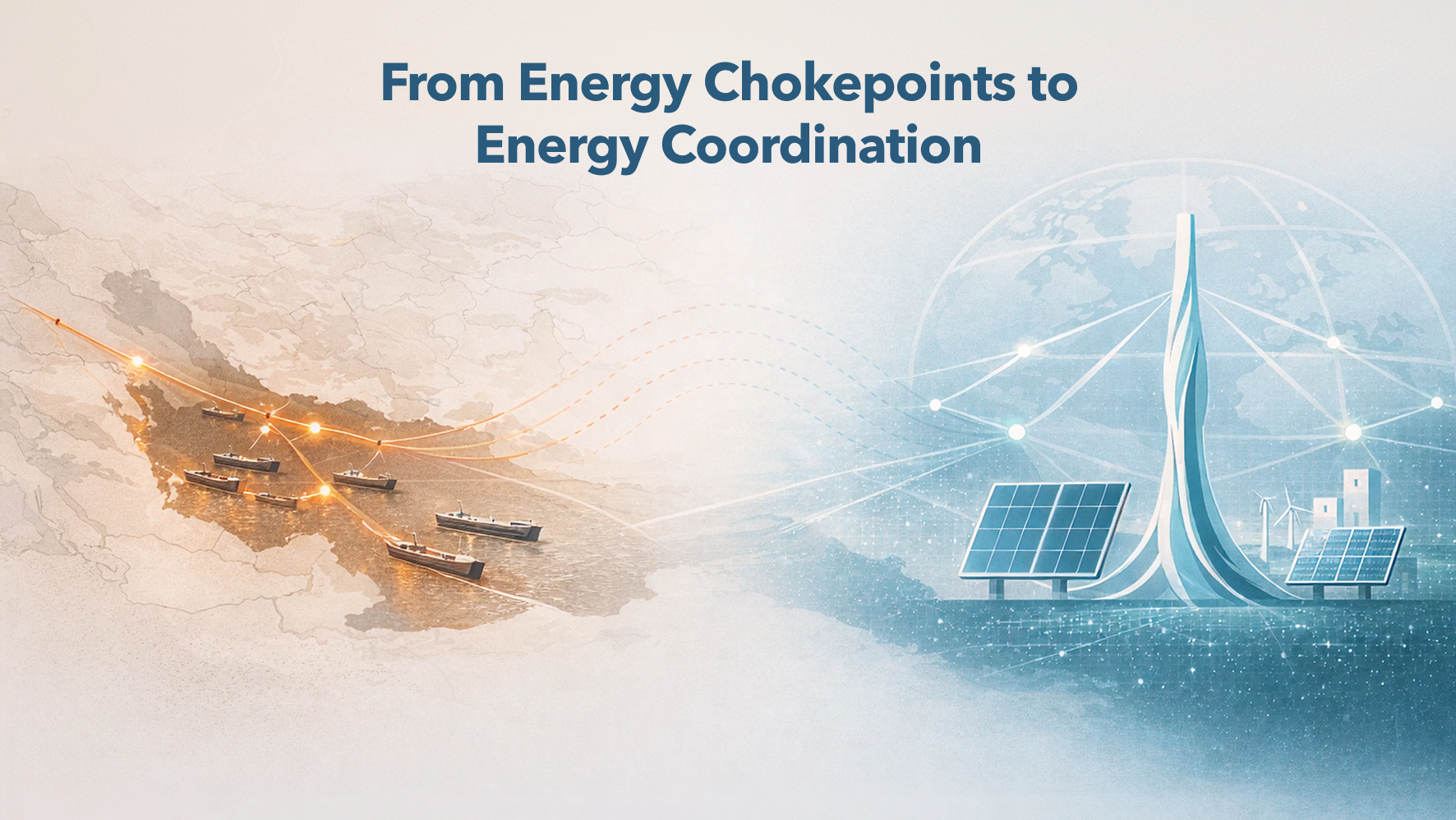
The world is entering a new energy era.
The ongoing attacks on Gulf energy infrastructure, the damage at Qatar’s Ras Laffan complex, the disruption of LNG flows, and the de facto closure of the Strait of Hormuz have pushed energy security to the top of the global agenda. Brent surged above $119 during the latest escalation, while gas markets across Europe and Asia absorbed the shock immediately.
This moment reveals a deeper truth.
Oil and gas built the industrial age. They also created a global system built around chokepoints, concentration, long-distance exposure, and political fragility. When a single corridor carries around a fifth of global oil and LNG flows, the entire world economy stands on a narrow bridge. Recent events have shown exactly how exposed that bridge has become.
The consequences move swiftly.
Energy prices rise. Inflation pressure returns. Industrial planning weakens. Semiconductor supply chains feel the pressure. Strategic stockpiling grows. Countries race to secure alternatives. The market begins to reprioritize resilience, proximity, verifiability, and sovereign control.
This is where the opportunity opens.
The crisis in the Middle East is accelerating the formation of a new energy economy. One where clean generation becomes instrumental. One where delivery requires innovation. One where infrastructure must be measured in energy security, continuity, and trust, rather than purely in output. One where energy moves from a commodity story to an infrastructure coordination story.
That is the space Sync Neural Genesis AG was built to serve.
Sync begins with the source.
The Sync ecosystem is built around sovereign-grade clean generation infrastructure at national and continental scale. The pipeline spans renewable energy development across jurisdictions and turns generation into a foundational source layer for the wider system. This creates the base of a new energy economy: real production in the gigawatts, anchored in long-duration national infrastructure.
From there, energy must move.
AEIR brings the transmission breakthrough. It introduces wireless energy transmission infrastructure designed for precision, controlled delivery, and deployment across environments where legacy grid expansion moves too slowly, costs too much, or reaches physical limits. In a world where cables, substations, and maritime routes carry growing risk, AEIR’s wireless energy transmission flexibility becomes strategic power.
Then comes proof.
A new energy economy needs every unit of energy to be verifiable across generation, transmission, and consumption. That requirement grows even stronger during crisis, when volatility, scarcity, and geopolitical risk raise the value of trusted records. Sync addresses this through a system architecture built around measurable energy events and physical validation.
Then comes settlement.
Netzium serves as the settlement layer of the energy economy. It is purpose-built to record, verify, and settle real energy events. Its design aligns digital settlement with physical energy reality, giving nations, operators, and institutions a durable system for energy accounting, reporting, and coordination. Settlement becomes a strategic function. Trust becomes infrastructure.
This is the shift that matters.
For decades, generation, transmission, and settlement evolved in separate and fragmented worlds. The current crisis is forcing convergence. Energy now demands a unified architecture where source, movement, verification, and settlement operate as one system. Sync’s architecture brings those layers together: clean generation through the Sync pipeline, wireless delivery through AEIR, and verified settlement through Netzium.
That creates a new kind of resilience.
Countries gain cleaner domestic and regional generation capacity. Energy moves with greater speed and flexibility. Infrastructure becomes easier to verify. Cross-border coordination gains a common settlement language. Strategic dependency begins to fall as sovereign capacity begins to rise.
The market is already pointing in this direction.
Saudi Arabia is pushing more crude through Yanbu to bypass Hormuz disruption. Importers across Asia are reassessing supply concentration. The Gulf conflict is driving a permanent reorientation of energy flows, investment priorities, and strategic planning. That reorientation creates the opening for new infrastructure models with stronger resilience and cleaner foundations.
Sync’s role in that future is clear.
Sync acts as the coordination layer of the new energy economy. It connects renewable generation, wireless transmission innovation, and immutable energy settlement into one coherent system. It turns fragmented energy infrastructure into an integrated framework. It gives sovereign actors a path toward cleaner, predictable, secure, and more measurable energy systems.
The old energy order concentrated power in narrow corridors.
The next one will distribute energy through stronger infrastructure, cleaner generation, smarter transmission, and verified settlement.
The crisis has made the need visible.
The opportunity now is to build the system that answers it.
That is the work of Sync.


